
The all-electric future: Are we making energy simpler or more complicated?
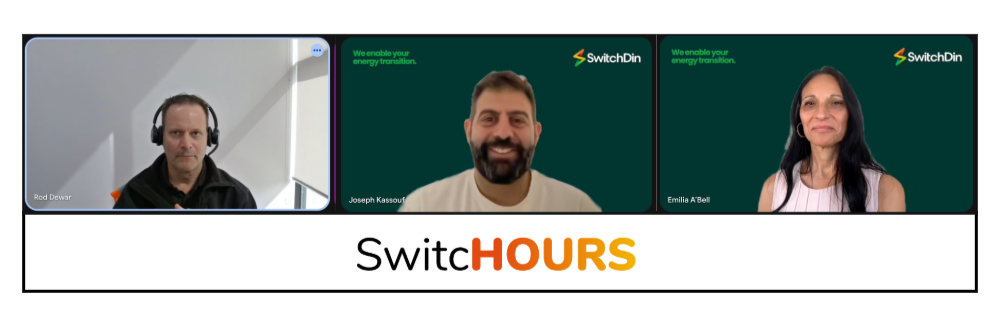
The clean energy transition is supposed to be the great simplification — fossil fuels out, clean electrons in. But ask anyone actually building in this space and a different picture emerges. For our first SwitcHOURS session, Rod Dewar from Fronius, Australia and Joseph Kassouf from SwitchDin along with our host Emilia A’Bell, got into the parts of the all-electric future and shared their perspectives on what's broken, what's overrated, and what the industry needs to stop pretending isn't a problem.
Is the all-electric future an interoperability minefield — or a genuine integration opportunity?
The honest answer is that it's both. And the industry doesn't always get to choose which one it's dealing with on a given day. Interoperability isn't a problem that gets solved once. New devices, new firmware, new protocols, new regulations — the landscape keeps shifting, which means solutions that work today can become liabilities tomorrow. The challenge isn't complexity itself. It's that the complexity compounds faster than most frameworks can keep up with.
That said, complexity at scale does create something: a genuine need for platforms that can cut through it. The question is whether the market builds those platforms with resilience in mind, or just reaches for whatever's easiest right now.
Is IEEE 2030.5 actually the right protocol for remote DER control?
Probably not the ideal design — it's verbose, it's "chatty", and no one is pretending it's elegant. But it's what exists, and more importantly, it's what DNSPs needed to get meaningful visibility over distributed energy resources on the grid. Without that visibility, grid stability becomes genuinely hard to manage as more homes and businesses plug in solar, batteries, and EVs.
The pragmatic case for 2030.5 is simple: the industry needed a starting point, and debating the perfect protocol while leaving networks blind wasn't a real option. Imperfect standards, consistently adopted, beat perfect standards that never arrive.
“No one had a better idea at the time — and DNSPs needed that visibility to manage grid stability. You start somewhere.”
Does growing complexity create an opportunity for platforms to simplify things?
It does, but simplification built on a single vendor is a different kind of risk dressed up as a solution. The residential market already leans heavily toward single-vendor ecosystems because they're easier to install, easier to support, and easier to explain to a homeowner. That preference is rational. Installers aren't wrong to want setups that don't require three support lines and a compatibility matrix.
The problem surfaces when that single entity becomes critical infrastructure. The industry has seen this play out, when a platform disappears, everything built on top of it is suddenly fragile. Simplicity that concentrates dependency isn't resilience. It's deferred risk.
What's actually stopping Virtual Power Plants from scaling?
The technology works. The aggregation model is sound. What's breaking VPPs at the mass-market level isn't engineering, it's the tariff structure sitting underneath it. Network demand tariffs, as currently designed in many jurisdictions, hit households disproportionately hard. For a homeowner weighing up whether to participate in a VPP, the numbers often don't add up not because VPPs are a bad idea, but because the commercial environment around them actively works against the proposition.
Until network tariffs catch up with the distributed energy reality, VPPs will remain a compelling concept that struggles to scale beyond early adopters.
“The complexity isn’t just technical — it’s what the network tariff structure is doing to ordinary households trying to participate.”
Can AI cut through the interoperability problem?
The instinct to reach for AI as the fix makes sense on the surface. The problem looks technical, AI solves technical problems. But interoperability in clean energy isn't fundamentally a technical problem. It's a commercial one. Competing interests, misaligned incentives, and a fragmented vendor landscape don't get resolved by a smarter model. They get resolved by open standards and the commercial will to adopt them.
AI has a role to play eventually. But deploying it before the standards foundation is in place means building on sand.
“The issues we’re dealing with are commercial. Until the standards piece is resolved, AI is solving the wrong problem.”
What does all of this mean for OEMs?
It means the product never really ships anymore. Hardware companies built their business model around a transaction — design, manufacture, sell, move on. Connected devices changed that entirely. Now every product that leaves the factory is the start of an ongoing obligation: software updates, security patches, protocol compliance, grid integration requirements. The business model that made sense for selling inverters doesn't map cleanly onto maintaining a networked device that sits inside someone's home for fifteen years.
Some OEMs are adapting. Others are still working out what the shift demands — and the gap between the two is becoming harder to ignore.
What's next
Be part of the next SwitcHOURS session
Come as a speaker with a perspective worth sharing. Come as an attendee with a hard question. Either way, the conversation is better with you in it.
Join the next session →